Advanced 3D Printing Lab at Manipal Institute of Technology Transforms Prototyping and Innovation.
3 March 2026
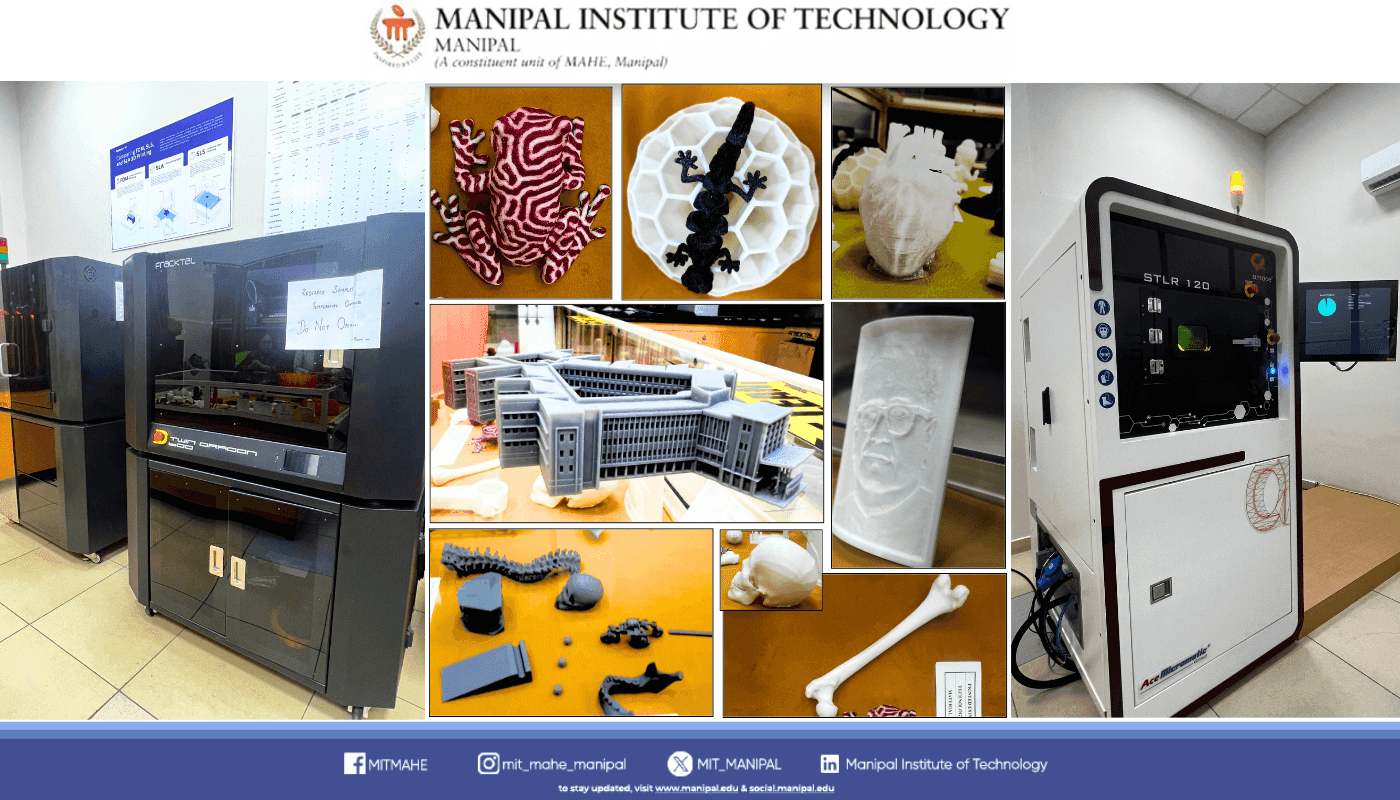
A requirement identified during the pre-COVID period has evolved into a state-of-the-art additive manufacturing facility at MIT, Manipal. The initiative gained momentum when Team Parikshit, the institute's student satellite team, approached the MIT Workshop seeking to fabricate a highly complex component that could not be produced efficiently using conventional machining methods. This request highlighted the critical need for rapid prototyping capabilities and contributed to the establishment of a dedicated 3D printing lab in 2020, marking a significant advancement in the institute's technological framework.
Today, the facility houses nine polymer-based 3D printers valued between ₹9 lakh and ₹15 lakh, along with a state-of-the-art metal 3D printer worth ₹1.26 crore. The advanced metal system, which operates on Laser Powder Bed Fusion (LPBF) technology, is renowned for its precision and capability to fabricate complex metallic geometries, with an approximate operating cost of ₹800 per hour. These machines utilize highly accurate layer-by-layer melting of metal powder, enabling the construction of up to 5,000 layers in a single build, with each layer as thin as 0.03 mm. Their versatility supports the production of high‑performance, functional components such as lightweight lattice structures, topology‑optimized designs, conformal‑cooling inserts, intricate internal channels, as well as high-detail jewelry components and patient-specific body implants—applications that are difficult or impossible to achieve through conventional manufacturing.
To further support the revised first-year curriculum, an additional 20 polymer 3D printers will soon be added to the facility, ensuring adequate access and hands-on learning opportunities for incoming students.
The lab offers academic printing services free of charge, while custom design solutions and product modifications are provided based on user-specific requirements. A trained junior engineer oversees the facility’s operations to ensure strict adherence to quality and safety protocols. Beyond technical prototypes, the lab also produces illuminated 3D impressions that serve as distinctive personalized souvenirs.
Highlighting the importance of experiential learning, the Workshop Superintendent, Dr. Suhas Y. Nayak, encourages students to fully utilize this advanced infrastructure. He emphasizes that any digitally crafted model can be seamlessly transformed into a precise physical product, thereby fostering a strong ecosystem of innovation and hands-on skill development at the institute.
Other
News

1st May 2025