Program Details
Understand and apply principles of semiconductor devices and fabrication technology.
Design, model, and verify VLSI circuits and systems.
Work with FPGA architectures and embedded hardware platforms.
Apply testing, diagnosis, and verification methods for VLSI circuits.
Use industry-standard EDA tools for electronic system design.
Design and implement measurement, monitoring, and control systems using sensors, transducers, and process control techniques.
Apply automation technologies and smart monitoring systems to industrial and manufacturing environments.
Integrate hardware and software solutions for semiconductor, embedded, and automation applications.
Our meaningful collaborations with industry leaders and global universities enhance your career opportunities and higher education pathways:

Broad Electronics Foundation: You study analog and digital circuit design, semiconductor devices, embedded systems, and intelligent automation before specialising.
Two Specialisation Tracks: You choose between VLSI Design and Technology or Instrumentation Engineering, and the track you complete is named on your degree.
Hands-on Tool and Laboratory Exposure: Practical training with leading Electronic Design Automation tools and modern laboratories supports real-world design capability.
Hardware and Software Integration: Our curriculum bridges hardware design with software development across VLSI, embedded, and automation applications.
Alignment with National Initiatives: Our program supports India's Semiconductor Mission and the "Make in India" initiative by developing industry-ready engineers.

Lab Work
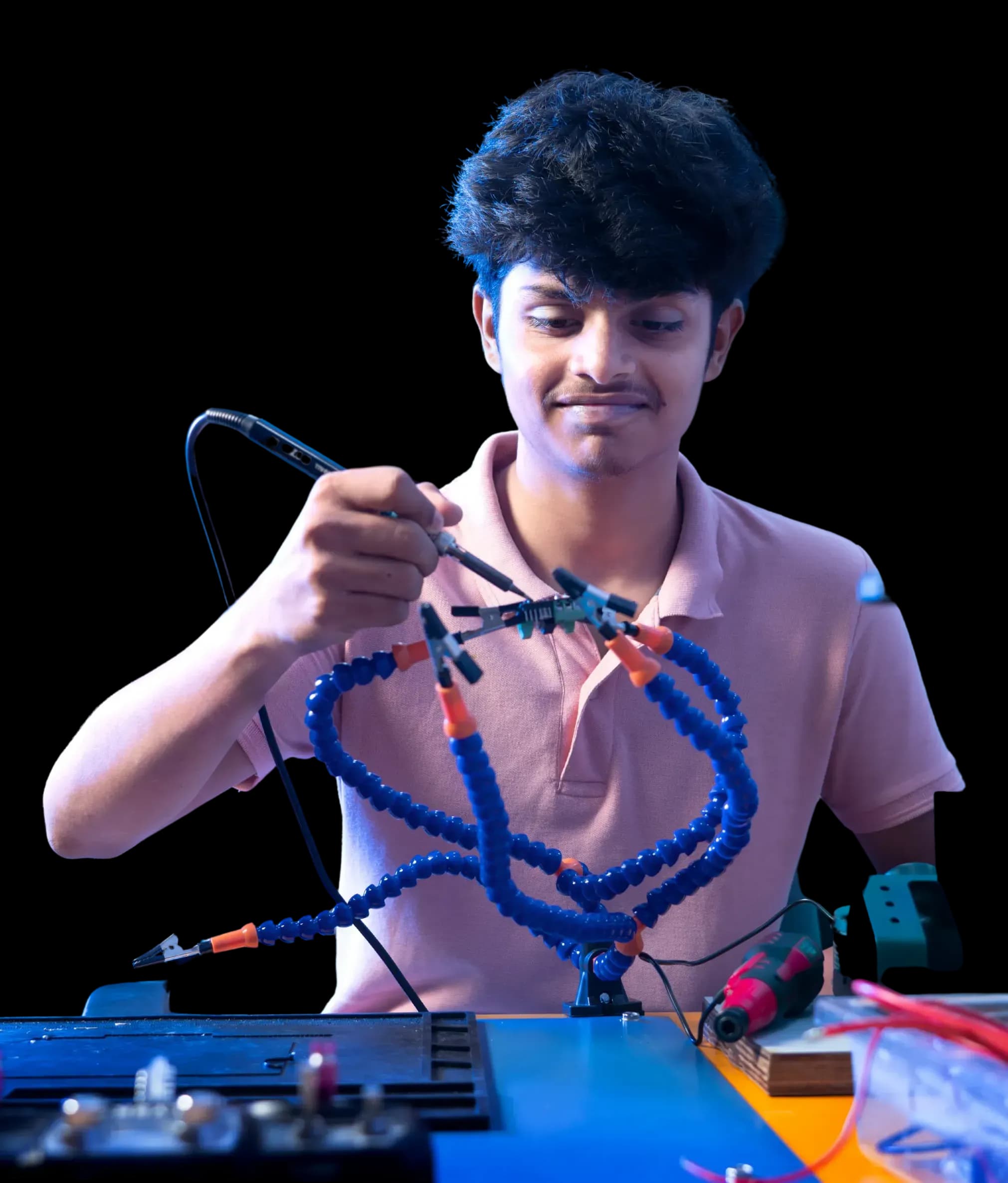
You receive structured laboratory training in semiconductor devices, VLSI design, FPGA implementation, fabrication-related experiments, sensors, and process control systems.
Lab Work
You receive structured laboratory training in semiconductor devices, VLSI design, FPGA implementation, fabrication-related experiments, sensors, and process control systems.
Admissions Path
JEE Mains 2027
Merit List based on JEE Mains Rank as per Common Rank List (CRL)
MET
Merit List based on 50% weightage given to MET score and 50% weightage to the marks obtained in 10+2 examinations (Physics + Mathematics + Chemistry / Optional Subject + English) Score
Program Eligibility
Based on MET Rank
Pass in 10+2 or equivalent with Physics, Mathematics and English as compulsory subjects along with Chemistry / Biotechnology / Biology / any technical vocational subject* as optional, from a recognized Board, with minimum 50% aggregate marks taken together in Physics, Mathematics and any one of the optional subjects
Based on JEE Mains CRL Rank
Pass in 10+2 or equivalent with Physics, Mathematics and English as compulsory subjects along with Chemistry / Biotechnology / Biology / any technical vocational subject* as optional, from a recognized Board, with minimum 75% aggregate marks taken together in Physics, Mathematics and any one of the optional subjects
The candidate MUST be having 90 Percentile or above in JEE Mains 2027
Based on MET Rank
Based on JEE Mains CRL Rank
The candidate MUST be having 90 Percentile or above in JEE Mains 2027
Based on MET Rank
Based on JEE Mains CRL Rank
The candidate MUST be having 90 Percentile or above in JEE Mains 2027
*Technical vocational subject must be related to Chemical / Civil / Computer / Electrical / Mechanical streams
#University of Cambridge GCE ‘A’ Levels / Edexcel GCE ‘A’ Levels / British Examining Bodies
Curriculum and Fees
Curriculum details will be updated shortly
Program Duration
Total Program Fee (2026 Admissions)
General:
NRI/Foreign:
Note : Fee structure for 2027 admissions will be updated shortly
Scholarships
Manipal Academy of Higher Education (MAHE) Manipal awards scholarship for its Undergraduate (UG) and Postgraduate (PG) students under the following categories


Related Courses